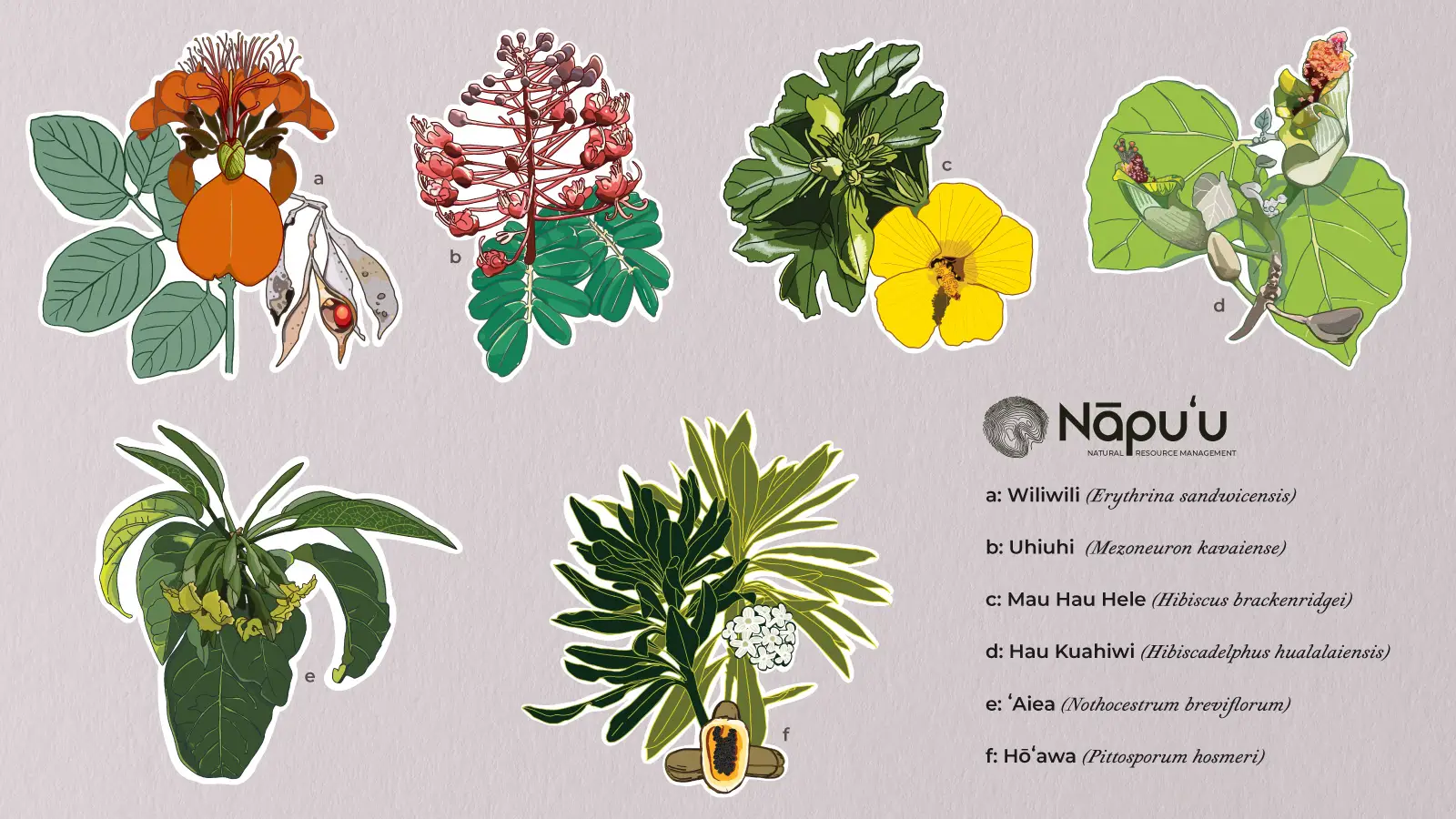
A series of six highly detailed botanical illustrations of native Hawaiian dryland species. Created for education and outreach, each illustration was developed in multiple formats including full-color artwork, line art for coloring pages, and inverted versions for stamps and stickers.
Nāpuʻu Natural Resource Management, managed by the Hawaiʻi Department of Land and Natural Resources (DLNR) Division of Forestry and Wildlife, oversees restoration and conservation efforts at Puʻuwaʻawaʻa, managing native dryland species and operating a greenhouse for propagation. They needed a set of botanical illustrations for educational outreach that showcased the unique characteristics of specific native plants including flowers, leaves, seeds, and other identifying features.
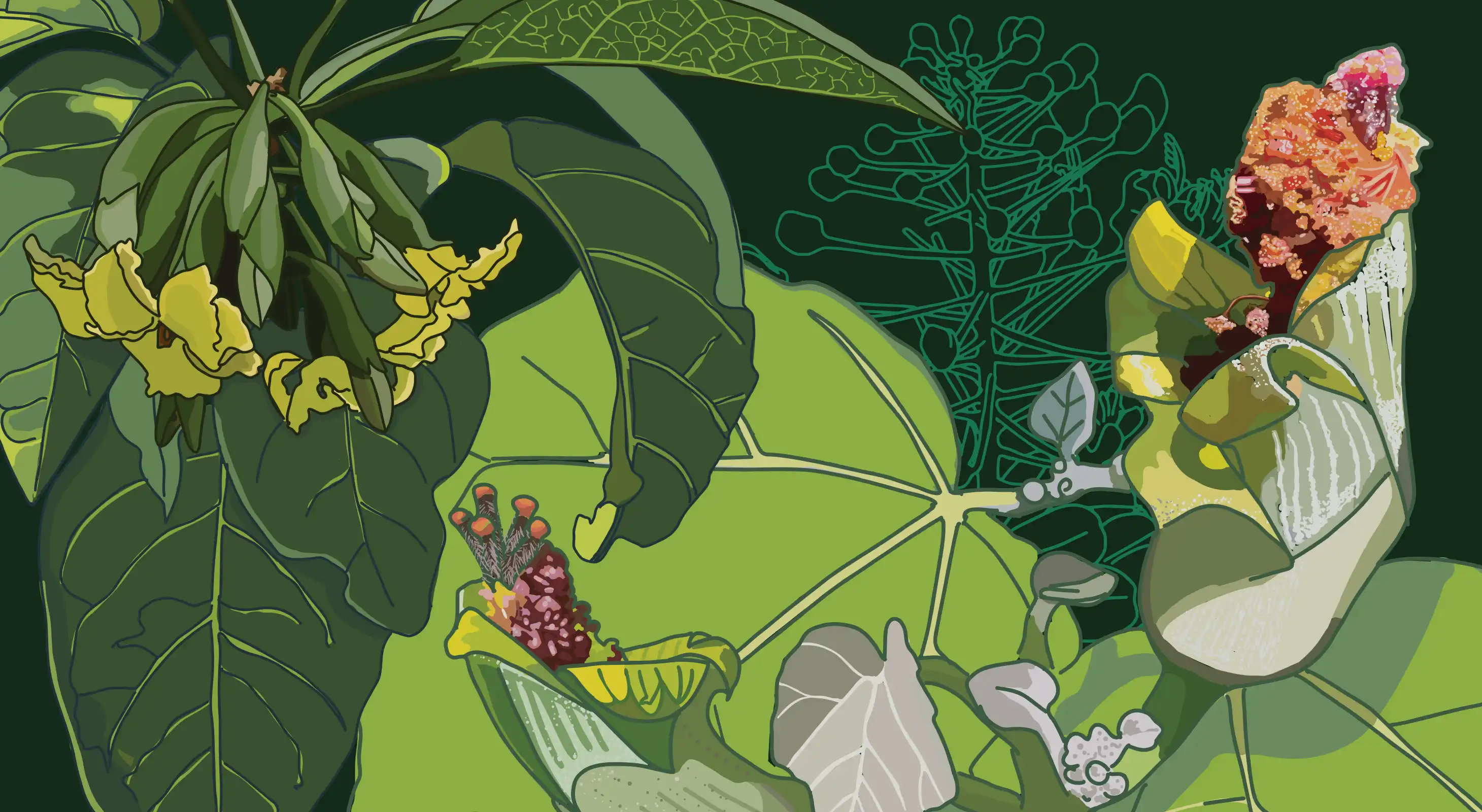
I illustrated six native Hawaiian dryland species: Wiliwili (Erythrina sandwicensis), Uhiuhi (Mezoneuron kavaiense), Mau Hau Hele (Hibiscus brackenridgei), Hau Kuahiwi (Hibiscadelphus hualalaiensis), ʻAiea (Nothocestrum breviflorum), and Hōʻawa (Pittosporum hosmeri). Each was rendered at 6000-pixel resolution to ensure flexibility across print and digital applications. The illustrations follow a flat vector style with botanical accuracy, showing multiple aspects of each plant in a single composed view.
Each illustration was delivered in three formats: full-color artwork with vector outlines for kiss-cut sticker production, black line art on white backgrounds for coloring pages, and inverted white-on-black versions for stamps and alternative applications. The compositions were carefully arranged to balance scientific accuracy with visual appeal, making them suitable for both educational materials and public engagement.
I visited the site to photograph reference material for plants where existing images were insufficient, then composited multiple reference photos in Photoshop to create the base compositions. The final illustrations were created in Adobe Fresco using a flat vector approach, then refined in Illustrator to add the kiss-cut sticker outlines and prepare the alternate formats.
The high-resolution delivery ensures these illustrations can scale from small web graphics to large-format prints without losing clarity or detail.
The biggest challenge was sourcing and compositing reference imagery. Botanical illustration requires showing multiple features of each plant (flowers, leaves, seed pods, growth habits) in a single composition, but reference photos rarely capture everything needed in one shot. I spent significant time researching each species, photographing plants on-site at Puʻuwaʻawaʻa, and digitally compositing multiple images to create accurate, well-balanced compositions before starting the illustration work.
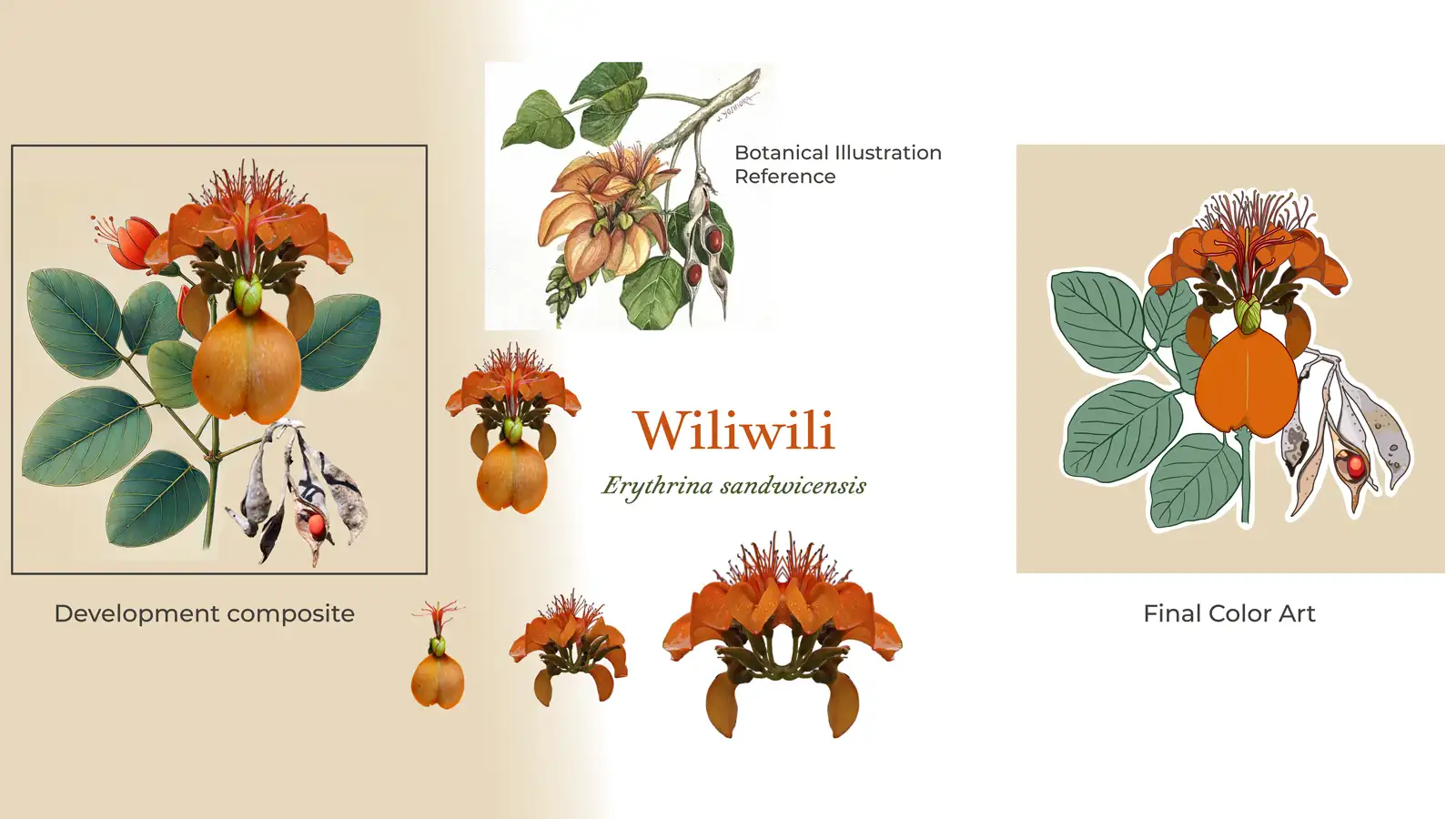
Developing the illustration style took longer than anticipated. I created at least four different style explorations before landing on the final flat vector approach that balanced botanical accuracy with visual accessibility. The client was slow to provide feedback during the exploration phase, so I ultimately made the executive decision to move forward with the style that best served the project goals.
Working at 6000-pixel resolution in Fresco required careful file management and performance considerations, but it was necessary to ensure the illustrations could be used at any scale. Each plant took considerable time to illustrate due to the level of detail required to capture the unique characteristics the client wanted highlighted.
Creating three distinct formats from each illustration (full-color, line art, inverted) meant additional production work, but it gave Nāpuʻu maximum flexibility for future applications across educational materials, merchandise, and outreach campaigns.
Full-color illustrations of six native Hawaiian dryland species, shown at full composition and in detail to highlight botanical accuracy and illustration quality.