Custom aircraft livery design for Hawaiʻi Helicopters' Maui-based fleet, constrained to two colors and optimized for real-world visibility from ground to aerial perspectives. 3D rendering workflow in Modo enabled precision collaboration with aircraft painters, resulting in a design that captures the fluid relationship between air and water.
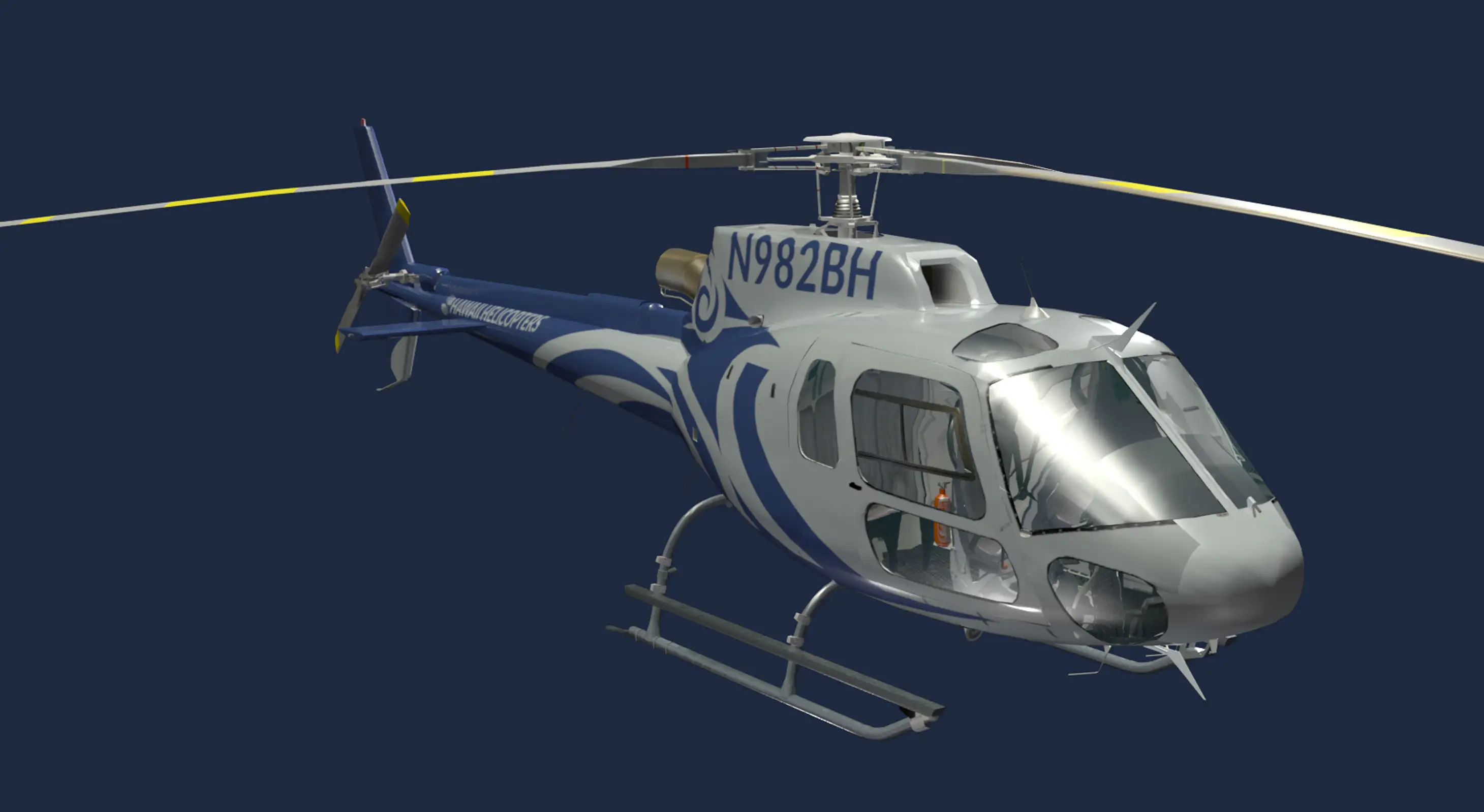

Hawaiʻi Helicopters needed their Maui-based fleet to stand out in flight against coastline and cloud. The constraint was two colors only, no gradients, no photographic process. Just clean vector work that would read from every angle.
The breakthrough came from a free .lxo helicopter model I found online. I trialed Modo to create a proof-of-concept: a 3D render dropped into an aerial photograph of the Maui coastline. That single composite was the hook. Hawaiʻi Helicopters hired ʻĒna Media Hawaiʻi based on that image, and I purchased Modo to complete the project.
The design captures the fluid relationship between air and water through flowing, organic curves that spiral around the fuselage. It feels native to Hawaiʻi's environment without defaulting to tropical clichés. These helicopters launched in September 2016, and Andrew Hara shot them in flight along the Kohala coast, exactly the environment I'd designed them for.
The two-color constraint forced simplicity and clarity. I built the design in Illustrator as pure vector artwork, knowing it would need to scale from website thumbnails to full-size paint masks. The flowing curves reference both ocean swells and atmospheric currents, creating motion even when the aircraft is stationary.
The 3D workflow was essential for execution. I taught myself enough Modo to UV-map the livery design onto the fuselage and rendered the helicopter from multiple angles: how the pattern would wrap around compound curves, how it would read with doors open, how the tail connected visually to the main body. I used Adobe Fuse to create posed passengers in the cockpit, adding realism and scale to the renders.
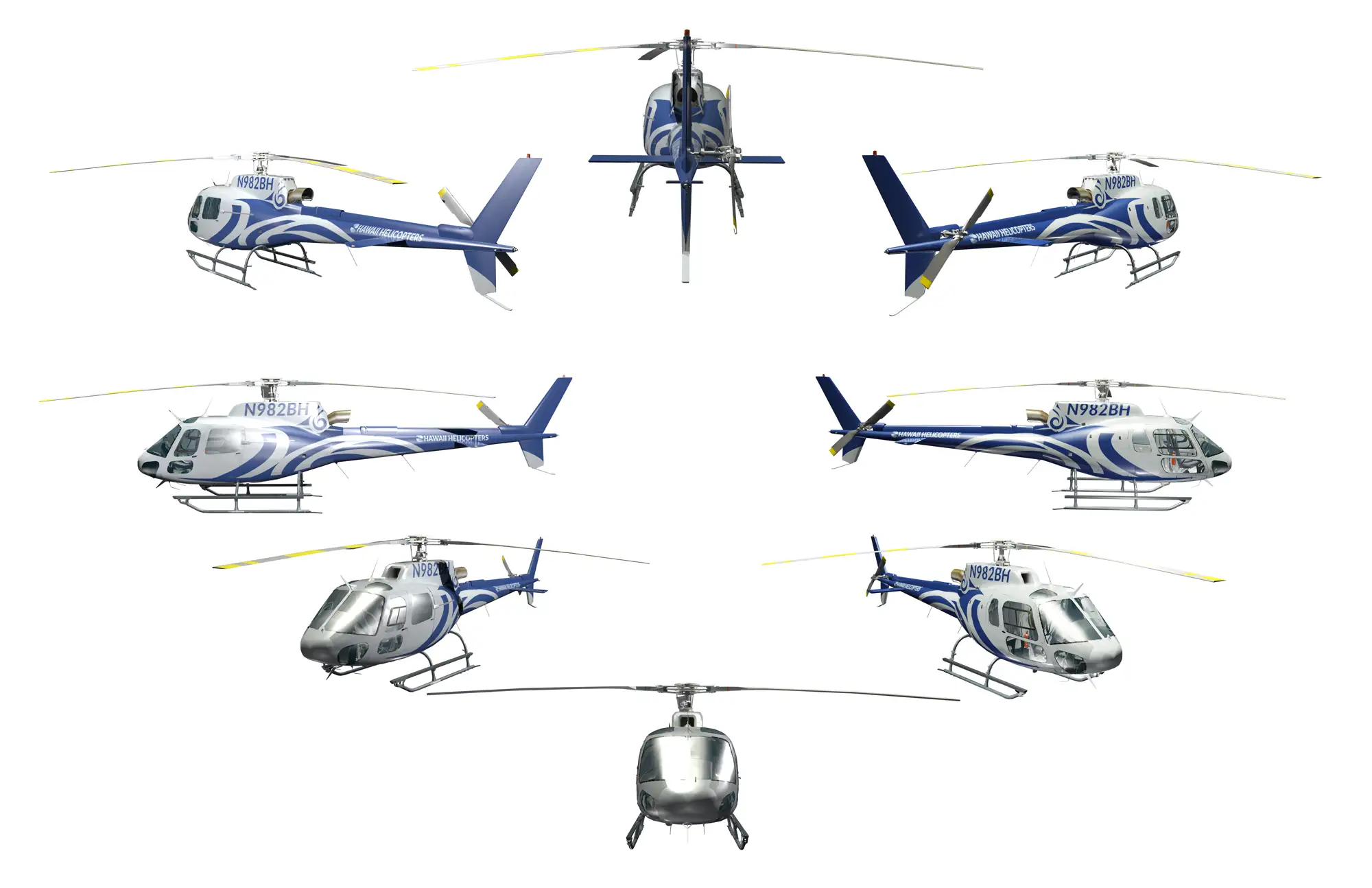
Working with the aircraft painter on Oʻahu required translating design intent into fabrication specs. We discussed which body panels could be painted as continuous surfaces, where we'd need to mask around windows and doors, how to handle the transition from fuselage to tail boom. The painter knew exactly which compromises would be invisible and which would break the design.
The final aircraft reads clearly from every angle. The two-color restriction feels intentional, and the pattern photographs well in countless tourist shots without being distracting to pilots or passengers.
3D visualization and final photography showing the two-color livery design in action along Hawaiʻi's coastline.